Nothing But A Body
A Short Review of Tilly Lawless' debut novel.

Tilly Lawless’ 2020 debut Nothing But My Body begins in a dingy brothel with the unnamed narrator privately admonishing her clientele; it ends with a meditation on friendship and freedom as she guns down Sydney’s Victoria Road in what at least feels like a convertible. This would be an unremarkable way to bookend a novel, compatible with a number of Vonnegut’s classic story shapes. Indeed, in the final action of the book Tilly specifically invokes the cinematic language of classic American films, recalling the ‘into the sunset’ endings of The Breakfast Club and Grease. However, the implicit suggestions of the text’s structure problematize this ostensible narrative unity.

The book is an auto-fictional account of the lived experience of an Australian sex worker over thirteen months. Specifically, it is eight days out of those thirteen months, a period which appears to extend from June 2019, prior to the Black Summer bushfire season, to July 2020, when the New South Wales government prematurely rolled back its Sydney-wide Covid lockdown. This timeframe might be incorrect, and could be moved forward or backwards by a few months. Whatever the case, it does not much matter as each chapter is a self-contained vignette. We leap between a wide variety of venues in which the narrator conducts their work, as well as clubs, bush properties, Mardi Gras festivals, and nude beaches, among other locales. This suits the narration, a cascading, immediate, and somewhat neurotic style that caroms between our narrator’s nearest preoccupations (her torn cuticles, how much money she’s made that day, the nearest bodies in work and life) and her higher considerations (the place of sex work in Australian society, her relation to normative love, and ‘queerness’ in its broadest form).
It is out of this contrast that the explicit themes of the book are revealed. In the first chapter the narrator is consumed by insecurity as to her girlfriend’s gambling habit and emotional instability, at once compromising their relationship and embroiling the narrator in guilt for contemplating ending it. After work, she appears to attempt a kind of suicide in her bathtub, fails, passes out, and resolves to end the relationship by extricating herself out of it and into London.
Never again. I am not going to burn myself on the pyre of romance, on a future that exists only in my imagination.
Immediate romantic tribulations -and flights to London- are never mentioned again, underlining Lawless’ rejection of heteronormative romance as a vehicle for actualising oneself. What follows is a spiralling consideration of the alternatives, the centrepiece being the libertarian affections -the free love, you might say- characterised by the queer community. This is typically called ‘Friendship’ within the text, to distinguish it from heteronormative ‘Love’, and is couched in a wider intersection of everyone that is not a cis white man. Consider the following passage, which nicely encapsulates this view:
I don’t know if it is my queerness that has made me this way, but for me the blood of the covenant is thicker than the water of the womb. And ‘friend’ is a hallowed term in my mind, one I value more highly than ‘family’.
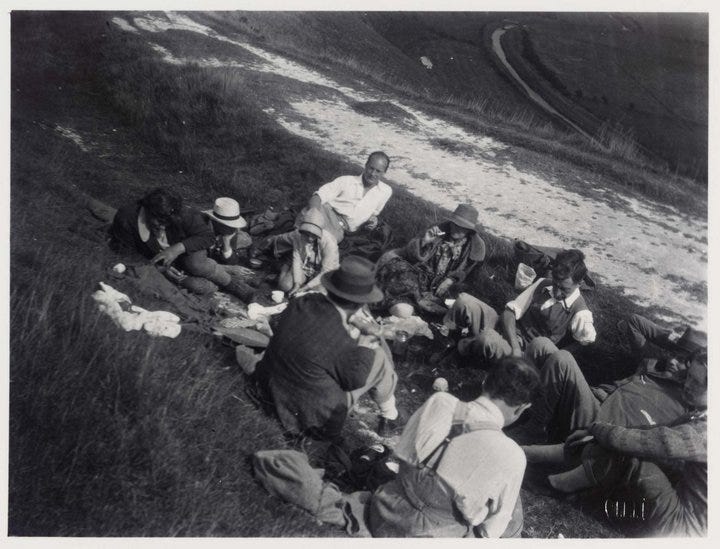
It is Lawless’ contention throughout this text that monogamous familial and sexual relationships as the foundation of at least Australian society is a top-down imposition enforced by the -cis white male- state. She posits this aforementioned structure of Friendship as an alternative, which contains within itself the broadest ambit of sexual, racial, and gender identity. (As an aside, astute readers might recognise this as resembling the ethical principles of the Bloomsbury Group, as G. E. Moore put it: “one's prime objects in life were love, the creation and enjoyment of aesthetic experience and the pursuit of knowledge.” According to Lawless, Nothing But My Body was modelled on Virginia Woolf’s Mrs Dalloway.)
Unfortunately, this thesis fails, not because there is necessarily anything objectionable in it but rather because Lawless appears incapable of placing her positions outside of a neoliberal context, which is the context that reinforces heteronormativity. Take for instance this passage in the middle of the book, where the narrator is celebrating Mardi Gras:
‘What are your brands?’ someone next to me asks, and I must’ve been carrying on a conversation while my imagination was off frolicking in my future, and so I say, ‘I’m not really into brands.’
‘No, I mean what are your pronouns?’
‘Oh, right, lol, sorry – she/her. You want to get up on the platform with me?’
While the above is a rather farcical example, the language of modern capitalism drowns the book. Money is an ever-present consideration, perhaps the only consistent motif throughout the text. When the lockdowns are foisted upon Sydney and the narrator is unable to prosecute her work, and though she does decry that it will be more consequential for the Asian immigrant sex workers ineligible for government assistance, the reader is primed to respond most viscerally to her own financial woes. The reader is primed by her constant insistence that this is a living, a valid living, and that out of this living she can go to Berlin or Paris on her own dime, among other things. The lockdowns prevent this as much as her ex-girlfriend did. When the lockdowns end, the great signifier of her freedom is her freedom to fuck, and that to fuck is to earn.
Moreover, there is an explicit reduction of the wide variety of characters within the text to their essential characteristics. Bar three minor characters, one of which is not present when they individuated, no one is named. They are rather referred to as the trans guy with a strap-on; the seven months pregnant woman; the three Aboriginal drag queens; the older gay man; the widower. These are positioned, consciously or not, as transactive categories in which sex or conversation or virtue can be exchanged. They are commodified by their anonymity. This ultimately serves to reduce every person within the story to nothing but their body.
This occurs largely because the language deployed by the book -much of which is derived from the Gender Studies Degree that Lawless majored in- has been completely internalized by the neoliberal establishment. It becomes impossible to position oneself outside of a neoliberal context when employing its language -whether it originated that language or not- and so while openly critiquing that context appears to tacitly request approval and incorporation thereof.
As such, the work ultimately fails to prosecute its positions effectively, it fails to meet its own parameters. This brings us back to the conclusion. That conclusion (that driving into the sunset) appears to betray the principle that Lawless attempts to develop by reifying the culture in which it occurs. This ultimately leaves this alternative of queer liberation where it began: in a dingy brothel.
⁂
Afterword
I wrote this review in early 2023. It is in fact a condensed version of an essay that ended up being 5,000 words in which I utilised this text to explore a concept I will one day unveil at length, a concept which I have since termed ‘Sympathetic Criticism’. That is, literary criticism that evaluates a written work on the basis of how it fulfils or fails to fulfil its own stated parameters. I also trialed ‘Parametric Criticism’ and ‘Assumptive Criticism’, but these both sounded too theological for my tastes.
In any event I thought that 14 pages criticising this minor entry in the canon was in poor taste, as it is a debut, and so I shelved the essay. Nonetheless, this condensed version is a fair and serviceable review, and so I am not entirely sure why I failed to post it earlier—perhaps I thought it was too harsh. Non iam.