
Conventional Love
On Margaret Drabble's The Millstone

It would be fair to say that the matter of abortion and its associated subject matters, such as single motherhood, are somewhat sensitive. The matter draws strong feeling, and both sides of its discourse have compelling reasons for holding and prosecuting their respective positions. The agency of young women; the humanity of the unborn. They can both be very compelling, and it is only a fool that suggests it is actually a very simple matter. That it is controversial is not in and of itself a controversial assertion, and consequently the literature that assumes one position or the other is typically received with aplomb.
There are classical examples, a canon of sorts, non-fictional and fictional. Judith Thomson and Rosalind Hursthouse, Margaret Atwood and John Irving. Pope John Paul II and Sidney Callahan, P. D. James and Edith Wharton. There are many ways of examining the vicissitudes of abortion: theological, feminist, biological, economical, that can be and are variably employed by either camp, and they often make one weep. They make me weep, at least. This is all well established.
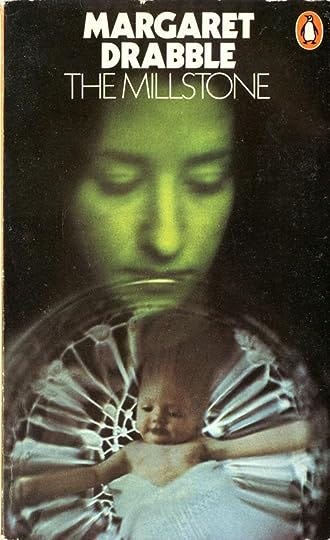
Because tensions run rather high, here, it was refreshing to read a book that treated the subject with a high degree of what you might term nonchalance. This was Margaret Drabble’s The Millstone. The title alone is funny, the image of an infant strung around one’s neck like a great agricultural wheel or an albatross, which was only reinforced by the copy I ironically purchased for two dollars within a Brotherhood of St. Lawrence op shop. Why is the woman green? Is the baby trapped in a crystal ball or projecting some kind of psychic field? Is the baby making the woman green? It beggars at least my belief that this could go through the various quality controls in Penguin’s marketing department and end up on the revolving wire rack of a pharmacy, where it would have been sold in the sixties when this edition was published.
Rosamund Stacey is a typical 60s socialite, swanning about London, attending dinner parties and pubs, gossiping about people and books, and makes do on a pittance of a stipend for a PhD on Shakespearean sonnets while living for free in her parents’ vacated apartment. They’re off on a civil service adventure in South Africa. Though raised in a theoretically socialist household, she is fundamentally middle class. But there is something odd about Rosamund, particularly among her cohort, which she herself admits to: that she is terribly averse to sex.
My crime was my suspicion, my fear, my apprehensive terror of the very idea of sex. I liked men, and was forever in and out of love for years, but the thought of sex frightened the life out of me, and the more I didn’t do it and the more I read and heard about how I ought to do it the more frightened I became.
At the outset of the novel, she obfuscates this fact, her latent virginity, by way of (in her words) deluding two men whom she is seeing simultaneously into believing that the other one is her true lover. These are Roger Anderson, a well-to-do, baby-faced Tory accountant with a disagreeable but assiduous attitude; and Joe Hurt, a tall, ugly novelist with the typical passions and anxieties of such an artist. But in fact while this is her front it is not either of these men that she ultimately condescends to sleep with, but rather George Matthews, a BBC Radio newsreader that she initially regards as camp and gentle. As it goes, Rosamund has an argument with Joe at a pub, and after the latter storms out George, whom she only knows passingly, makes her acquaintance by chance. They talk, and he insists on walking her home in a way that she regards as chivalrous, so she invites him up to her apartment. After small pleasantries they sleep together for reasons that Rosamund cannot really articulate, and this is the first example of what I will be calling ‘conventionality’.
The form of the narrative is communicated from deep within Rosamund’s sensibilities, which are at once self-conscious and extremely judgemental. Drabble does not -so far as I can surmise- ever stoop to the idealistic or the emotive in describing the events of the novel or Rosamund’s reaction thereof. Where concise, descriptive idiom eludes her, so too does it elude the reader. If something is ambiguous, it remains so. On one hand this is very English, influenced by Jane Austen’s own supposition that one can only form their moral opinions within and yet apart from social convention, which itself is downstream of Adam Smith’s Theory of Moral Sentiments. In this respect Rosamund, leading her life in such an insular way, is inhibited in her ability to characterise her own and others’ actions. And this is not an idle supposition on my part: Drabble has provided introductions to several of Austen’s novels, and it has been previously observed that her writing is an attempt to continue the tradition of the English novel, and so she is almost certainly in dialogue (that dreaded term) with Austen’s philosophy. On the other hand, it is stilted insofar as drawing out Rosamund’s motivation is concerned. She doesn’t even consider it, lying in bed after George has left.
As I tossed and turned and tried to find a cool place for my cheek on the pillow, it became increasingly clear to me that he had made no overture at all: that I myself had made the decisive move, in going to sit next to him on the settee after switching on the radio, and that what I had taken to be a look inviting me to do just that had probably been nothing of the sort. I had offerred myself, and thinking what he did of me he accepted, through kindliness or curiosity or embarrassment; not in any case through anything like the tender emotions that had prompted me.
What tender emotions, you may ask? We never learn as such. In any event Rosamund falls pregnant, and after a sophomoric attempt at an abortion involving a bottle of gin and a warm bath, and then an irresolute call to an abortionist (“I rang the number once, but it was engaged. After that I went no further.”) she makes the decision to have the baby, or rather fails to decide not to have it. And it is odd how this indecision elapses, because she spends exactly an hour and fourteen minutes in the waiting room of an NHS clinic, observing dowdy, ill, or obese women and their petulant children.
Those who looked worst of all were, ominously enough, the mothers: there were four mothers there with young children, and they looked uniformly worn out. One held a small baby on her knee, at which she smiled from time to time with tired affection and anxiety. The others had larger children, two of which were romping around the room; they were doing no harm, apart from disturbing the magazines, and nobody minded them except their mothers, who kept grabbing them and sleeping them and shouting at them in a vain and indeed provoking effort to make them sit down and keep quiet.
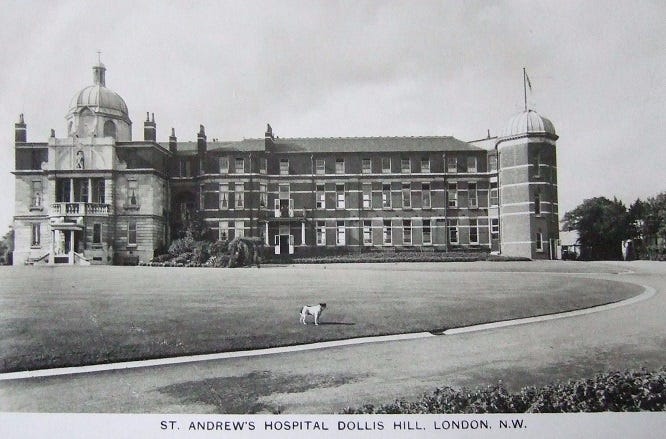
And yet at no point does she change her mind, or comment as to their bearing on her state of mind. This is so textually restrained. Drabble rarely hints at inner turmoil, of gladness or fear or anger. The narratological eye of Rosamund is almost exclusively pointed outwards, and even where she pauses to examine herself, stops short of the sort of interiority a reader may expect. Time passes, she parts way with Joe and Roger, pauses her tutoring of a trio of perhaps dated archetypes (a Greek, an Indian, and a Methodist Minister, for those physiognomic readers), and secures a bed at the reportedly sterling St Andrew’s Hospital. She is examined at length by St. Andrew’s nurses, suffers through procedures and her own swelling body, and occasionally thinks of George. This latter case is one of the few instances in which the reader receives insight into her feelings as to the circumstances of her pregnancy, but even this is elliptical and incomplete.
George, George, I thought of George, and sometimes I switched on the radio to listen to his voice announcing this and that: I still could not believe that I was going to get through it without telling him, but I could not see that I was going to tell him either. I would have the odd two minutes when I would think of him, and such grief and regret and love would pour down my spine that I tried not to think.
She speaks to her friend, Lydia, who will later move in with her, about her own miscarriage; suffers further procedures; continues her dissertation; idly considers her actions (or lack thereof). Free will, a lack thereof, irrational self-justification: “this hinterland of unwilled consequences and confused values”. They pass before her, but at no point does she draw closer to making some firm determination, and it appears to me that this is the point. While waiting for farther medical examinations, following her theorising, a mother asks her to hold onto her sleeping baby while she herself is examined. The baby’s nose is running and he proves warm and damp, and she worries that this dampness will stain her coat. Yet a sense then overcomes her, as to its “small warmness” and “wide soft cheeks” and “quiet, snuffly breathing”. She holds it tighter and closes her arms around it, until the mother returns.
Drabble is not, as such, stating that this infant contains an explicit or definite value. That would require going beyond the conventionality that Rosamund inhabits, the vantage from which she narrates, and this is in fact impossible. Rosamund would not even have the language for it. Rather, Drabble is indicating what is felt, in large part by refusing to describe Rosamund’s feelings in the first place. This is what is so fine, here, so carefully put. The Millstone is not a book of moral pronouncements for or against abortion or the virtues of single mothers, indeed Rosamund says terrible things about both. Instead, it needles towards this indescribable sentiment that we sometimes hold and struggle to articulate. This is perfectly encapsulated when, following some patter, Rosamund’s water breaks and, suffering through the midwives’ gossip, gives birth. She receives her child as follows:
She put her in my arms and I sat there looking at her, and her great wide blue eyes looked at me with seeming recognition, and what I felt it is pointless to try to describe. Love, I suppose one might call it, and the first of my life.
It is quite something for a good writer to admit that something is pointless to try to describe, and the manner in which this is stated, here, is what gave me such an affection for The Millstone.
She calls the baby Octavia, and resumes much of the academic work she had foregone during her pregnancy. But Octavia grows ill, and she is diagnosed with a heart disorder that requires dangerous and invasive surgery. Through this she meets a surgeon, Dr Protheroe, and it comes about that this doctor knows her father, and they chat amiably around the agonising question of whether to operate on Rosamund’s newborn, and also around the less agonising but far more awkward question as to whether Rosamund’s parents know she has a daughter. I shan’t beat around the bush, the baby survives, and they are reunited through a scene that I recommend reading firsthand. In my edition it’s pages 133 to 135. In any event, when they at last return home Rosamund receives a letter from her parents, in which they indicate that rather than returning to England following the expiration of their posting in South Africa they will go onto India, which is at first a relief to her, only for her father to finish the letter with the following:
I had a letter from our old friend Dick Protheroe last week, who says he has been seeing something of you.
And it is by whit of Rosamund’s mulling over the meaning of this sentence that Drabble writes the book’s most Austenian passage:
Their behaviour seemed natural to me, for I am their child, but I have speculated endlessly about whether or not they were right. Such tact, such withdrawal, such avoidance. Such fear of causing pain, such willingness to receive and take pains. It is a morality, all right, a well-established, traditional, English morality, moreover it is my morality, whether I like it or not.
At last, Rosamund meets George again, the night before Christmas. She has descended her apartment to seek some medicine within a 24-hour chemist for little Octavia, who is still recovering from her surgery, when she encounters him. They exchange a little bit of nothing, she lets slip that she has a child, and invites him to come along and see his erstwhile daughter. He only views her a short while, and soon leaves, but not before the following exchange:
‘Yes,’ I said, ‘I’ll look after myself. Let me know if you do go away. If you go abroad.’
‘I’ll let you know,’ he said. ‘And you, don’t you worry so much.’
‘I can’t help worrying,’ I said. ‘It’s my nature. There’s nothing I can do about my nature, is there?’
‘No,’ said George, his hand upon the door. ‘No, nothing.’
And this is the same tact, withdrawal, avoidance, which she proudly ascribes to her parents and to herself, and this is a kind of conventionality. Within these few quaint remarks is an expression of the love that Rosamund has for George, the father of her child, and yet the shouldering of a huge amount of pain in allowing him to slip away unburdened by that knowledge. This technique of Drabble’s, to carefully compress so much emotional content into so little, indeed by eliding the emotions themselves, is what has stuck with me. It is also instructive in a period where such technique is rarely implemented and, rarer yet, implemented well.
⁂