
Assault as Bargaining
On Thomas C. Schelling and being assaulted aboard the Craigieburn Line

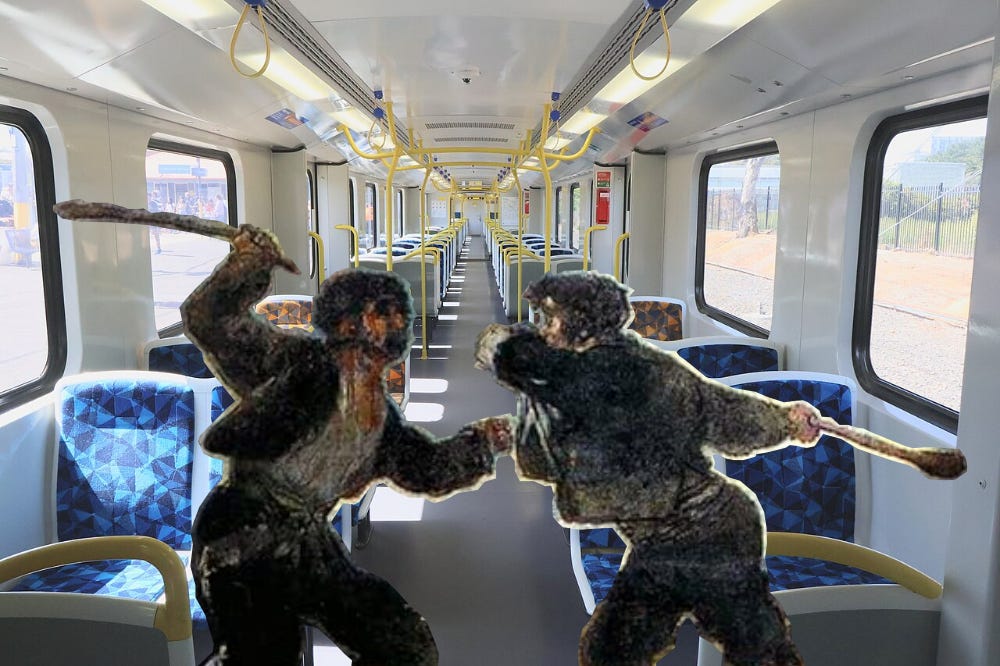
Sometimes, when we read, the world conspires to validate whatever the content of that reading is. I have been reading Thomas C. Schelling’s The Strategy of Conflict, and I also punched someone for the first time in as long a period as I care to recall. In the latter case, I was sitting on the train with my girlfriend, having picked her up from work after drinking with some friends. All was well, I was pleasantly buzzed, she was tired but happy to be accompanied home, and we inspected the NYT Cooking app for that week’s meals. The train was a Siemens Nexas and so the seats were arrayed 2+2, in foursomes if you like, and the seats across from us were yet to be occupied.
I had noticed—for I am always keeping an eye out—when a rather disgruntled man with a soju bottle and a camouflage jacket boarded our carriage at Flinders Street Station. I quite liked his fit, but he was muttering to himself typical antipathies with imagined interlocutors, rising and falling, cussing without end, and I’d an intuition that he would prove a problem. I consider myself a reasonably humane person, that people are people, and I only use the following epithets because they acutely capture what I have just euphemistically described. A junkie, a schizo, a tweaker. They are ubiquitous across Melbourne, and I have anecdotally observed that their number is increasing. This is quite an aside, but I still find them confronting. When and where I grew up, addicts were not such a problem or rather were an invisible problem, contained to public housing estates on the very suburban fringe of Launceston, their lots backed by bush. But since moving to the big smoke, I’ve learned to ignore them, give them their space, tune out their fulminating like the call of exotic birds, and so I did the same to this fellow1.
Only he then sat across from me, and diagonally from my girlfriend. Fair enough, I’d shared 2+2s with his kind before and nothing had become of it. I continued discussing possible meals with my girlfriend in gentle tones. It had been a good, long day, and I was ready to shower and sleep. Then, apropos of nothing that I could discern, he began stomping on my leg, which hurt badly. Now, having evaluated the event in retrospect, I don’t think his object was the violence itself, but to have the 2+2 to himself. Herein, and however irrational, this small assault was a kind of bargaining on the part of my assailant. Schelling puts this succinctly as “situations in which the ability of one participant to gain his ends is dependent to an important degree on the choices or decisions that the other participant will make”. Schelling also has much to say about irrationality, which I wish to include to validate the supposition that this particular event can be productively analysed:
The apparent restrictiveness of an assumption of “rational” behaviour — of a calculating, value-maximising strategy of decision — is mitigated by two additional observations. One, which I can only allege at second hand, is that even among the emotionally unbalanced, among the certified “irrationals”, there is often observed an intuitive appreciation of the principles of strategy, or at least of particular applications of them. I am told that inmates of mental hospitals often seem to cultivate, deliberately or instinctively, value systems that make them less susceptible to disciplinary threats and more capable of exercising coercion themselves. A careless or even self-destructive attitude toward injury — “I’ll cut a vein in my arm if you don’t let me…” — can be a genuine strategic advantage; so can cultivated inability to hear or to comprehend, or a reputation for frequent lapses of self-control that make punitive threats ineffectual as deterrents.
Our principal participant is of the latter kind, cultivating the suggestion that normal, observed rules of behaviour are an ineffective means by which one is to determine their choices. This cultivation is a kind of commitment, which is Schelling’s principal innovation within the field of game theory:
A pure commitment — that is, a definite commitment to a pure strategy — is equivalent to “first move” in a two-person, two-move game in which one would otherwise have to move second; it is a means of obtaining the equivalent of first move.
That is, a commitment is a manner by which some truth as to the limits of one’s ability or willingness to negotiate are made known to the other participant, which therefore constrains their choices. This could be as simple as crossing one’s heart when making a declaration, or as complex as acquiring insurance against certain unfavourable outcomes. It could characterise shifting one’s marginal production costs to a third party, revving one’s engine at an inexactly delineated intersection, trading Pokémon cards of a certain value, or, indeed, stomping on the second participant’s leg. Commitments come in a variety of forms and with a number of characteristics. A bargaining agent, such as a realtor, may be given instructions as to what offers they are and are not allowed to consider, and may or may not be incentivised to secure certain kinds of outcomes, such as a higher commission when the prospective buyer does not require a building inspector. The same is true of brokers and used car salesmen. One may secret away negotiations, such as when union delegates negotiate with an employer behind closed doors, or may be very public, as when the same union communicates some substandard offer to their membership to indicate that this is below their lowest negotiable bound. Negotiations may be intersecting or continuous, or subject to a restrictive agenda, as during tariff negotiations and certain kinds of criminal proceedings. They may involve a show of force, as in the case of limited war, and in this respect the limited war takes on the species of a threat, and this latter example is what our first participant was engaged in when he decided upon his course of action.
A threat occurs when one participant commits themselves to a course of action that is designed to deter or incentivise the second participant from committing to a different course of action by promising mutual harm should he do so or fail to do so, depending on the negotiations in question. In this respect a limited war, i.e. small hostilities, is not the object of negotiations but another tactic thereof, the tactic of brinkmanship, specifically, which Schelling describe as follows:
Brinkmanhip is thus the deliberate creation of a recognizable risk of war, a risk that one does not completely control. It is the tactic of deliberately letting the situation get somewhat out of hand, just because it’s being out of hand may be intolerable to the other party and force his accommodation. It means harassing and intimidating an adversary by exposing him to a shared risk, or deterring him by showing that if he makes a contrary move he may disturb us so that we slip over the brink whether we want to or not, carrying him with us.
Thus, Participant One’s stomping on my leg was, in effect, a threat. For purposes of simplifying the game theory involved, we will assume that Participant Two had two choices as to how they replied. They—I—could yield, retreat from the 2+2; or they could fight back. From this we can infer four possible choices on the part of Participant One as a result of either of these choices. In the event of Participant Two yielding, they may cease their assault and gain control of the entire 2+2, which is easily their best choice. Alternatively, they could continue assaulting Particpant Two, which is a perfectly fine choice so long as said participant continues to cower. In the event that Participant Two chooses to fight, Participant One can retreat, which is an unideal outcome as it would mean they have failed to secure the object of the negotiation. Finally, Participant One can escalate into a brawl, which is their worst choice as they have then failed to secure their object and also created a mutually harmful conflict wherein Participant Two fails to cower. This can be graphed as an ordinal decision tree as follows:
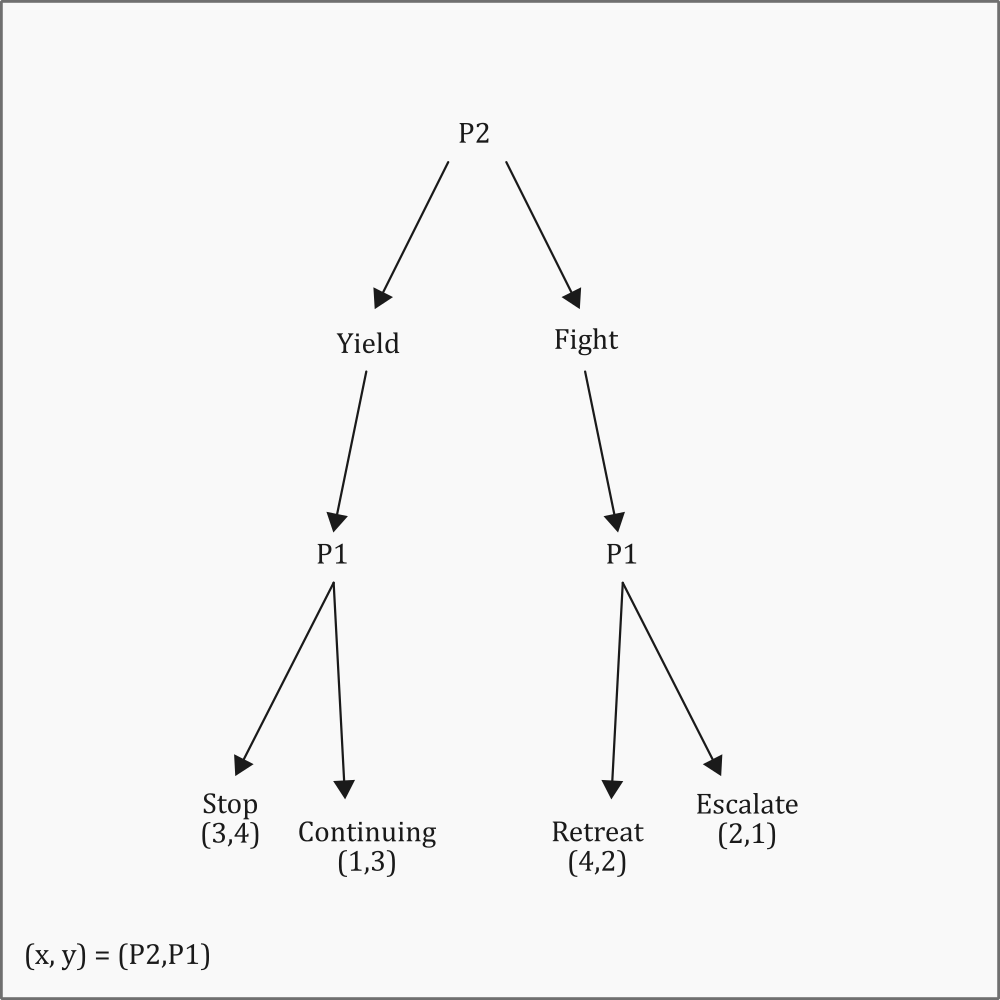
For Participant One: P1 Stopping > P1 Continuing > P1 Retreating > P1 Escalating.
For Participant Two: P1 Retreating > P1 Stopping > P1 Escalating > P1 Continuing.
Note that the above tree excludes the initial choice on the part of Participant One, as the exact set of choices available to him prior to commencing his assault is not known. We could use simple backwards induction to determine P2’s choice, but it’s obviously to Fight as Fight > Retreat is the equilibrium payoff at (4,2). I mulled over this tree for a while, tried to determine if there was some way to complicate it, to add another layer wherein subgame perfection could be observed, but I don’t suppose that one exists. Importantly, the above tree does not change if, upon P2 picking Yield, P1 turns on and assaults P2’s girlfriend, which is not realistically applicable should P2 pick Fight as P1 will be preoccupied. All that such a scenario would do is reduce P2’s absolute payoff under the Yield scenario even further, perhaps to 0.5, making Fight the maximally correct choice. Schelling anticipates the weakness of this kind of commitment as follows:
The distinctive feature of this threat is that the threatener has no incentive to carry it out either before the event or after. He does have an incentive to bind himself to fulfill the threat, if he thinks the threat may be successful, because the threat and not its fulfillment gains the end; and fulfillment is not required if the threat succeeds. The more certain the contingent fulfillment is, the less likely its actual fulfillment. But the threat’s efficacy depends on the credulity of the other party, and the threat is ineffectual unless the threatener can rearrange or display his own incentives so as to demonstrate that he would, ex post, have an incentive to carry it out.
We are back again at the commitment.
My assailant had reason to imagine me a credulous party. I wear glasses, and I was also wearing a scarf, probably had a rosy complexion. But this was evidently a mistaken impression. After sensing that P1 was stomping on my leg, I suppose after the third stomp, I stood and hooked him across the jaw. He immediately ceased his assault, cradled his jaw, and whined, “Ow, what’d you do that for?” I don’t know why, but that little complaint left me apoplectic. He stood, sensing the moment was lost, sensed (4,2), only for me to push him back over. “Kick me you cunt? I’ll fuck you up.” He skittered down the aisle, while I stalked him to the carriage door. We were, thankfully really, parked at a station, and he fled the train altogether, which I felt was sufficient. Now, when I sat back down, my girlfriend was not altogether pleased, said that she would have liked me to consider de-escalation. It was the examination of such a possibility that led me to consider the event in the above terms. I have turned it over repeatedly, graphed a number of outcomes, massaged my hand, and I can’t imagine a choice that would have resulted in a more optimal outcome. This is perhaps unfortunate, but interesting.
I had initially hoped to use the language of Schelling to diagnose the intricacies of blind boxes, Miniso and Pop Mart, and their relation to Australia’s gambling culture. I thought the logic involved in iterative purchases of a particular line of blind boxes would prove interesting, the threeway payoff between a repeat, a new addition, and the rare collectable; and the relationship between multiple participants, namely consumers, sellers, and resellers. This may yet be written, but both this aside and that potential article are really filler while I read and review a number of books that range from thrilling to poor. In any event, we ended up making BLTs.
⁂
Which we all do, however humanistic we imagine ourselves to be.
Craigieburn line has always been third world, my friend.
It is very exciting a confrontation of any kind.